When you’re disabled in America, the government complicates your finances. Whether you’re facing employment discrimination or contending with asset tests, these barriers are not fair, intuitive or logical. They can make balancing your budget ultra-tricky.
The good news is that there is a tool that can alleviate parts of the headache: ABLE accounts. And there is even better news. In 2026, millions more Americans will be allowed to access ABLE accounts, potentially bettering their financial situation.
Originally, you only qualified for an ABLE account if you were under age 26 at the time of onset of your disability. This disqualified a lot of Americans who were disabled later in life.
Luckily, in 2022, the ABLE Age Adjustment Act passed through Congress. This law bumped the age of onset up to 46 rather than 26. It was a cause to rejoice, but the implementation was delayed until 2026.
The waiting period has been frustrating for many, but the day is finally here. With the turn of the new year, 6-8 million Americans are newly eligible for ABLE accounts, including about one million disabled veterans.
Related: Learn how neurodivergent budgeters use PocketSmith to take their personal finances to the next level.
A major use case for ABLE accounts is to shelter your savings from asset tests. When you’re on SSI (Supplemental Security Income) as a single person, you’re only allowed to have $2,000 in your name. This makes building an adequate emergency fund impossible — unless you have an ABLE account. The first $100,000 held in your ABLE account does not count towards your $2,000 SSI limit.
Whether or not you’re on SSI, some states have asset tests for Medicaid eligibility purposes. However, CMS has ruled that any money held in an ABLE account cannot be counted as an asset for Medicaid purposes. The best part? There’s no cap on the dollar amount for this one.
The Department of Education (ED) also issued guidance that money held in an ABLE account does not count against you at all * * on the Free Application for Federal Student Aid (FAFSA). This is even more advantageous than a traditional 529 account, which is accounted for on the FAFSA at a rate of 5.64%.
Note: If you receive disability benefits, Social Security may approve extra budget for you to engage in financial literacy education activities. Frame this as a step towards independence, and you may be able to get things like a spending budget to practice managing money for recreational activities, or an extra expense allocation for budgeting software subscription fees.
When you’re disabled, housing can be a real issue. Whether because of asset tests or employment discrimination, it’s difficult to afford rent. While many turn to housing assistance programs, waitlists can be over a decade long. This is especially true for those who have accessibility needs, as the number of accessible housing units within these programs is extremely limited.
That makes homeownership an even more important goal for many disabled people, which often means saving up for a down payment. How do you save for a down payment, though, when you’re not allowed to have more than $2,000 in your own name — or whatever limit your state may put upon you for Medicaid access?
While there are other tools that can help you avoid asset tests, such as third-party supplemental needs trusts (SNTs), these tools are more expensive to maintain and manage. Importantly, they do not allow you to use funds for housing purposes. An ABLE account does, though. Out of all the uses for an ABLE account, saving up for housing needs is one of the most commonly cited goals.
Even if you’re not on SSI or have a high-paying job, an ABLE account can still be a valuable tool. That’s because when you withdraw money from an ABLE account, both the amount you deposited and the interest from your investments come out tax-free — as long as you use it for ‘disability expenses.’
The exact definition of disability expenses varies marginally from state to state, making it important to read your plan agreement documents thoroughly. But generally speaking, you cannot separate the disability from the person. That means nearly any personal expense you may have counts as a disability expense. Whether you’re paying for food, housing, vehicle modifications or a vacation, you can access your money tax-free.
Better yet, you can access this money tax-free at any age. Unlike a Roth IRA, which has similar tax advantages on the back end, you don’t have to wait until you reach retirement age to spend your money. With an ABLE account, you can spend your money as you need it without penalties.
That said, ABLE accounts aren’t like 401(k)s. You don’t get to deduct contributions from your income at the federal level. However, if you are contributing to your own ABLE account, you may qualify for the Saver’s Credit (soon to be reconfigured to the Saver’s Match program), giving you a slight advantage on your 1040.
Depending on where you file your state tax return, you may be eligible for a contribution deduction at the state level. Pennsylvania and Mississippi give you a drool-worthy, dollar-for-dollar deduction for ABLE account contributions (even if you’re contributing to someone else’s in-state ABLE account), and other states do partial matches.
In any given year, a single ABLE account can receive up to the federal gift tax exclusion amount across all contributions. In 2026, the maximum amount is $19,000. In future tax years, you may be able to contribute slightly more than the annual gift tax exclusion amount thanks to legislation that passed in the summer of 2025. However, that ‘extra’ amount is likely to be minimal.
If you have a job and don’t contribute to other retirement plans, you may be able to contribute extra, up to the Federal Poverty Line (FPL). These numbers are released in January of each year, but in 2025, they were:
That means, depending on where you live, this ABLE to Work Act allowance could double the amount you’re allowed to contribute in any given calendar year. Your employer may even pick up part of the tab, contributing to your ABLE account in much the same way as they’d contribute to someone else’s 401(k).
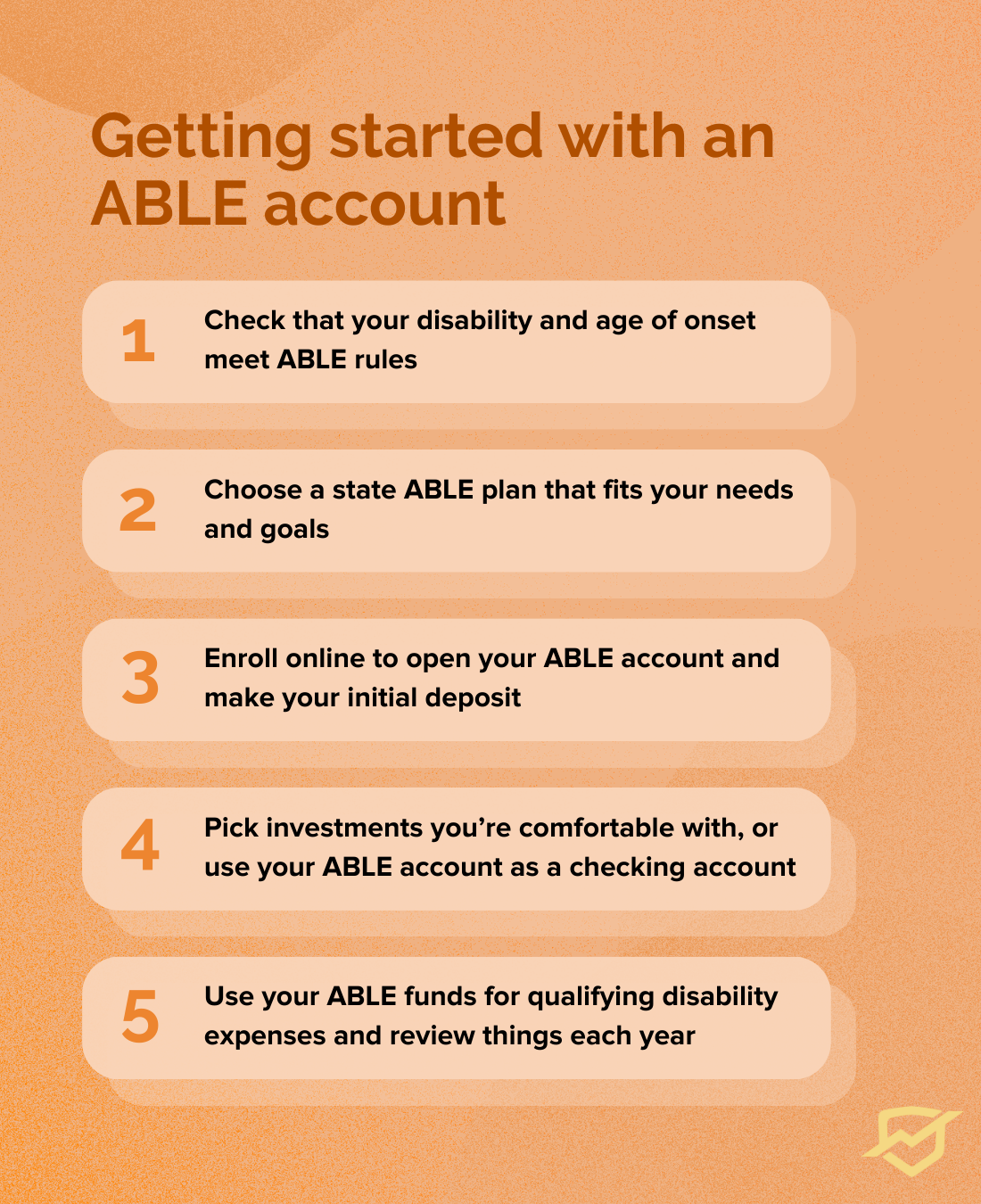
Whether you’re newly-eligible in 2026 or are just learning about your eligibility for the first time, signing up for an ABLE account is fairly easy. In many states, the process can be completed online in mere minutes.
You can compare plans across state lines by visiting ABLE today — a website run by the National Association of State Treasurers. You’ll be able to identify different state tax benefits, fees, investment options and more, allowing you to pick the state plan that’s most advantageous to you. If your state offers a state tax contribution deduction, the most advantageous plan is usually your home state.

Brynne Conroy is an award-winning personal finance writer, creator of the popular women’s finance site, Femme Frugality, and author of The Feminist Financial Handbook, which was an Amazon #1 New Release across multiple categories including Poverty and LGBTQ Demographic Studies. Her work has been cited in academic texts, and she’s spoken at venues such as Vanderbilt University, the Financial Planning Association and the 529 Conference. Here at PocketSmith, Brynne covers personal finance within American financial systems.